Showing posts with label FESTIVAL GREETING. Show all posts
Friday, March 18, 2011
Sunday, October 31, 2010
NIFTY AS ON 29/10/2010
Nifty As On Daily Charts Suggest That The Dowmove May Give A Pause Looking At Reliance Result And Shall Try To Move Towards 6050 – 6150 Levels Where 6150 Is A Hurdle Which Has To Be Cleared To Reach Towards The Peak Of 6284 Levels If This Levels Is Crossed Than Expect A Rally Towards The Peak By Diwali But Facing Resistance At Supply Zone May Drift The Market Toward The Lower Channel Monday Markets Might Open Flat To Positive And Shall Watch The Levels Given
Levels For The Week Are :
Buy At 5955 With Sl Of 5900 For The Target Of 6086
Breakout Above 6140 – 6150 Levels
Breakdown Below 5900 Levels
Operators Are Playing Game And Taking The Benefit Of The Volatile Markets It Is All Manuculation As The Premium On Expiry Was Very High No Retailer Was Able To Roll Over
The Swing Remains Down With Sl Of 6151
Hourly Charts Of Niftyfuture Also Denotes The Same Levels Of Resistance And Support Which Has To Be Played With Cautious Approch Still My Dates Remains The Same Of Prediction And A Correction Should End At This Levels And Start The Next Upmove But Markets Are Supreme And It Is Better To Follow The Trend
Bullish Views Of Square Of Nine Says That Nifty Spot Holding Close Above 5966 Could Go To 6464 Levels While Bearish Views Says That It Has Next Support At 5792 – 5673 - 5554
Sunday, September 19, 2010
NIFTY AS ON 17/09/2010
Story of God Ganesh

Lord Ganesh is the elephant-headed God, with one tusk. The legend of how he got his elephant head and one tusk is a fascinating one.
One day Parvati, Shiva's beloved wife, instructed Shiva's attendant Nandi not to let anyone in while she was taking a bath. A little later Shiva arrived wishing to enter. Nandi was in a dilemma as how to stop his master. Shiva entered Parvati was not ready to receive him. She was upset and wondered why Nandi had not obeyed her command. She complained to Shiva but Shiva did not take the matter too seriously. He was amused to hear that Parvati had asked Nandi to stop him from entering his own home. Parvati was annoyed. She shared her feelings with her friends. They teased Parvati by saying that she had no attendant of her own. They all considered Shiva their true master.
One of Parvati's friends came up with the idea to create a person who would owe his first
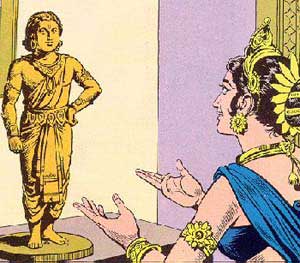
allegiance to Parvati and not to Shiva. So Parvati gathered the saffron paste (used at the time of bathing), from her own body and created a boy. The boy was handsome and strong. She gave the boy life and hugged him dearly.
"You are my son, my very own son, I do not have anyone elseto call my very own" said Parvati. Then Parvati gave the boy a staff and asked him to guard the door, "Do not to allow any one to enter without my permission."
A little later Shiva arrived and wondered who the boy could be and why was he there. His attendants did not know either. As Shiva approached the door, the boy stopped him. Shiva tried to explain to the boy that he was Parvati's husband and he had the right to enter without asking any one. The boy said without hesitation, "Halt, no one enters these halls without my mother's permission." When Shiva ignored him, the boy hit him with his staff. Shiva was furious. He tried to fight the young boy to realize that he was no ordinary boy. Shiva asked his attendants to capture the boy but single-handedly, the boy defeated all of them.
News reached Parvati through her friends and she thought, "Shiva is after all my husband." But she instantly argued, "But why should he try to force himself in without giving respect to the my privacy?" So she firmly conveyed her feelings to her friend, and she took the message to the boy, "Parvati has given definite instruction as not to allow any one to enter the palace. The boy declared, "I am the son of Parvati. I will give my life to carry out my mother's orders. No one can enter the palace without my mother's permission."
The messenger returned to Shiva and humbly informed him what the boy had said. Shiva's pride was hurt. Shiva was so angry that he sent his entire army to capture the boy. Parvati called for her other powers, Kali and Durga. She asked them to stand beside her son. Shiva's army lost the battle and the attendants ran for their lives. Shiva then called Vishnu to join him in defeating the small boy. This was not a fair fight. While the boy was engaged in fighting with Vishnu, Shiva threw his Trident and beheaded the boy. After the head rolled off, Shiva realized his mistake.
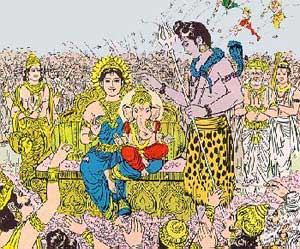
When Parvati heard of the unfair fight she decided to destroy the world. Brahma humbly approached Parvati, seeking for mercy to save the world. Parvati agreed on two conditions, "My son must regain his life and he shall be worshipped before any of the other gods." By that time Shiva had calmed down and apologized for his rash behavior. He agreed to bring the boy back to life. He asked Brahma to go North and bring the head of the first creature that crossed his path. Brahma left with his party and soon brought back the head of a strong elephant. The head was then fitted to the body of the boy and Brahma sprinkled water on it. The boy came to life with an elephant's head on his shoulder. Parvati embraced her son with joy. She then turned to Brahma to fulfill her second condition. Indra and the other gods brought Shiva to Parvati. Shiva apologized for his arrogance and declared "Hence on, this valiant boy will be my son. He will be respected as any other God and will be worshipped before any other God. He will be called Ganesh, the chief of my Ganas or attendants, and also Vigneshwar, the remover of all obstacles.
Shiva and Parvati once again began to live happily in their abode at mount Kailash.
Many years later, Shiva was taking a nap when Ganesh was guarding him. At that moment Parashuram, the Brahmin warrior, came to see Shiva. Much to his dismay he was stopped by Ganesh. Parashuram was unwilling to take orders from anyone. As a result, a big fight ensued. Finally, Parashuram threw his powerful ax towards Ganesh. Ganesh stopped the ax with his tusk which broke. Thus Ganesh lost one of his tusks and began to be known as Eka-danta, or "One Toothed."
Today before any venture is undertaken, it is Ganesh who is invoked and whose blessings are sought

Lord Ganesh is the elephant-headed God, with one tusk. The legend of how he got his elephant head and one tusk is a fascinating one.
One day Parvati, Shiva's beloved wife, instructed Shiva's attendant Nandi not to let anyone in while she was taking a bath. A little later Shiva arrived wishing to enter. Nandi was in a dilemma as how to stop his master. Shiva entered Parvati was not ready to receive him. She was upset and wondered why Nandi had not obeyed her command. She complained to Shiva but Shiva did not take the matter too seriously. He was amused to hear that Parvati had asked Nandi to stop him from entering his own home. Parvati was annoyed. She shared her feelings with her friends. They teased Parvati by saying that she had no attendant of her own. They all considered Shiva their true master.
One of Parvati's friends came up with the idea to create a person who would owe his first
allegiance to Parvati and not to Shiva. So Parvati gathered the saffron paste (used at the time of bathing), from her own body and created a boy. The boy was handsome and strong. She gave the boy life and hugged him dearly. "You are my son, my very own son, I do not have anyone elseto call my very own" said Parvati. Then Parvati gave the boy a staff and asked him to guard the door, "Do not to allow any one to enter without my permission."
A little later Shiva arrived and wondered who the boy could be and why was he there. His attendants did not know either. As Shiva approached the door, the boy stopped him. Shiva tried to explain to the boy that he was Parvati's husband and he had the right to enter without asking any one. The boy said without hesitation, "Halt, no one enters these halls without my mother's permission." When Shiva ignored him, the boy hit him with his staff. Shiva was furious. He tried to fight the young boy to realize that he was no ordinary boy. Shiva asked his attendants to capture the boy but single-handedly, the boy defeated all of them.
News reached Parvati through her friends and she thought, "Shiva is after all my husband." But she instantly argued, "But why should he try to force himself in without giving respect to the my privacy?" So she firmly conveyed her feelings to her friend, and she took the message to the boy, "Parvati has given definite instruction as not to allow any one to enter the palace. The boy declared, "I am the son of Parvati. I will give my life to carry out my mother's orders. No one can enter the palace without my mother's permission."
The messenger returned to Shiva and humbly informed him what the boy had said. Shiva's pride was hurt. Shiva was so angry that he sent his entire army to capture the boy. Parvati called for her other powers, Kali and Durga. She asked them to stand beside her son. Shiva's army lost the battle and the attendants ran for their lives. Shiva then called Vishnu to join him in defeating the small boy. This was not a fair fight. While the boy was engaged in fighting with Vishnu, Shiva threw his Trident and beheaded the boy. After the head rolled off, Shiva realized his mistake.
When Parvati heard of the unfair fight she decided to destroy the world. Brahma humbly approached Parvati, seeking for mercy to save the world. Parvati agreed on two conditions, "My son must regain his life and he shall be worshipped before any of the other gods." By that time Shiva had calmed down and apologized for his rash behavior. He agreed to bring the boy back to life. He asked Brahma to go North and bring the head of the first creature that crossed his path. Brahma left with his party and soon brought back the head of a strong elephant. The head was then fitted to the body of the boy and Brahma sprinkled water on it. The boy came to life with an elephant's head on his shoulder. Parvati embraced her son with joy. She then turned to Brahma to fulfill her second condition. Indra and the other gods brought Shiva to Parvati. Shiva apologized for his arrogance and declared "Hence on, this valiant boy will be my son. He will be respected as any other God and will be worshipped before any other God. He will be called Ganesh, the chief of my Ganas or attendants, and also Vigneshwar, the remover of all obstacles.Shiva and Parvati once again began to live happily in their abode at mount Kailash.
Many years later, Shiva was taking a nap when Ganesh was guarding him. At that moment Parashuram, the Brahmin warrior, came to see Shiva. Much to his dismay he was stopped by Ganesh. Parashuram was unwilling to take orders from anyone. As a result, a big fight ensued. Finally, Parashuram threw his powerful ax towards Ganesh. Ganesh stopped the ax with his tusk which broke. Thus Ganesh lost one of his tusks and began to be known as Eka-danta, or "One Toothed."
Today before any venture is undertaken, it is Ganesh who is invoked and whose blessings are sought
As said nifty is inching higher and higher without making any kind of correction and in overbought zone and still there is strength to touch 6030 levels in this week so on can hold long above 5740 and advise long to be added above 5800 with sl of 5740 and hold for higher targets still there is no weekness seen but there might be small correction in these week or side way movement between range of 5800 - 6030 levels
Now levels for the week are
5740 - 6030
Short term players may go long above 5800 with sl 5740 for target of 5960 - 6030 levels
shorting is not advise though market is overbought as per daily charts as the market is playing momentum and squeeze all the shorts in system so be away from the market or enter with strick stoploss
as nifty is in APNI HI MUSTI ME ZOOME RAHI HE ride the trend do not go against the trend.
swing remains up . There is no resistance faced by nifty as momemtum being strong nifty is moving higher and higher as now the left out people shall create euphoria on any kind of decline to earn fast
Saturday, September 11, 2010
NIFTY AS ON 09/09/2010
The Paryushana Parva
Two of the most important festivals for the jains are Paryushana and Diwali. Diwali is celebrated to commemorate the nirvana of Lord Mahaviara on the amavasya of the Kartika month. What is the historical basis of Paryushana?
Its origin is related to the staying of the monks in one place for the rainy season. "Paryushanaa" is staying of the monks in one place. In popular terminology this stay is termed "chaturmaasa" because the rainy season is regarded to be about four months. However the minumum duration of Paryushanaa is regarded to be 70 days. For this minimum duration, Paryushanaa must be initiated by panchami (fifth day) of the shukla phase of the Bhadrapada month. In the scriptures it is described that Lord Mahavira used to start Paryushanaa on Bhadrapada Shukla panchami.
The date for the Paryushana festival is thus Bhadrapada Shukla panchami for both major sects. Because of computational and other differences there can be some minor differences among various subsects. Recently there have been an attempt to get everyone to agree to use the same date.
Because at this time the monks have settled in the town for a longer duration, it is time for the householders to have an annual renewal of the faith by listening to the statement of the Dharma and by meditation and vratas (self-control). In the Digambaras, it is done by starting a 10-day period from Paryushana (Bhadrapada Shukla panchami) during which the dashalakshana vrata is undertaken. In the Swetambaras an 8-day festival is celebrated that ends with Bhadrapada Shukla panchami. The last day is called Samvatsari, short for Samvatsari Pratikramana, as described below.
During the 8-day festival, the Kalpa Sutra is recited in the Swetmbara sect, that includes a recitation of the section on birth of Lord Mahavira on the fifth day. In the Digambara sect the Tatvartha-sutra of Umaswati is recited. On the dashami, the sugandha-dashami vrata occurs. The Digambaras celebrate Ananta- chaturdashi on the chaturdashi, special worship is done on this day. Many towns have a procession leadinbg to the amin temple.
The original Prakrit(ardha-magadhi) term for Paryushana is "Pajjo-savana". Remember that in case of Jain terms, the prakrit forms of the words are the original.
Pratikramana (Samayika): Renewal meditation
Pratikramana means turning back. It is a form of meditation where one reflects on his spiritual journey and renews his faith. For both Swetambaras and Digambaras, it takes the form of periodic meditation. The period can be twice daily (morning and evening), once every lunar phase, every four months, or every year. The annual Pratikramana in some form is the minumum for a Sravaka.
The annual Pratikramana is Samvatsari Pratikramana, in short Samvatsari. Since it coincides with Paryushana, the terms "Samvatsari" and "Paryushana" are sometimes used interchangably.
Pratikramana includes
· Samayika: to stay in equanimity by withdrawing to the self.
· Prayers to the Five Supremes, 24 Jinas and the 4 mangalas, including the Dharma as presented by the ancient Masters.
· Prayer to the Master(Guru) or the Deity.
· Reflections on vratas and past transgressions.
· Kayotsarga: detachment from the body by controlling it.
Pratyakhyan: making resolutions for the next period (next year for Samvatsari Pratikramana).
The detailed recommended procedure can be found in the handbooks. Detailed Pratikramana takes about 3 hours, however all essentials can be done in a much shorter time if needed.
Pratikramana is also sometimes termed Samayika in the Digambara tradition.
By tradition certain postures are recommended for Pratikramana. They can be found in the handbooks.
Dasha-Lakshana Vrata
This is a vrata that celebrates 10 components of the dharma: Noble kshama (forbearance), mardava (gentleness), arjava (uprightness), shaucha (purity), satya (truth), sanyam (restraint), tapa (austerity), tyaga (renunciation), akinchanya (lack of possession) and brahmcharya (chastity), as described by Umaswati.
In the full form, it is a 10 day vrata that spans 10 years. It may be undertaken during Shukla Panchami to Chaturdashi of Bhadrapada, Magh or Chaitra. However it it common to do it during Bhadrapada, in which case it starts with Paryushana.
Requesting Forgiveness
At the conclusion of the festival, the Sravakas request each other for forgiveness for all offenses committed during the last year. This occurs on the the Paryusha day for the Swetambara and on Pratipada (first) of Ashwin Krashna for the Digambara.
Why we say "Michchhami Dukkadam" by P. Gada
Before I start on this I, myself want to say "Michchhami Dukkadam" toyou all. My dear friends Let us understand what is meant by "Michchhami Dukkadam" and why do wesay it? Michchhami means to be fruitless (forgiven) and Dukkadam (Dushkrut)means bad deeds. Therefore the meaning of Michchhami Dukkadam is my baddeeds (with you) be fruitless. So concept behind saying or writingsomeone "Michchhami Dukkadam" is that if I have done any harm to youthen those bad deeds to be forgiven (be fruitless). Those who did traditional Samvatsari (yearly) Pratikrman would remembersaying "Tassa Michchhami Dukkadam" at the end of many of sutras. Thereit meant that if I have committed any violations or transgressionsrelated to those minor vows or so then those violations be forgiven (befruitless). The following is the prayer we say while doing Pratikraman:"KHAMEMI SAVVE JIVE,SAVVE JIVA KHAMANTU MEMETTI ME SAVVE BHUYESU,VERAM MAJAHAM N KENAI"which has been read by readers of this list many times. Those who areborn in Jain families are familiar with the meaning and theme behindit. But when it is read or heard by those who are unfamiliar with it,then it may loose some concept in it though there was good discussionin this list. So as per my understanding by including some more words Ihave tried to expand its meaning and the scope which would make it moremeaningful. "I forgive (from the bottom of my heart without any reservation) allliving beings (who may have caused me any pain and suffering either inthis life or previous lives), and I beg (again from the bottom of myheart without any reservation) for the forgiveness from all livingbeings (no matter how small or big to whom I may have caused pain andsuffering in this life or previous lives, knowingly or unknowingly, mentally, verbally or physically, or if I have asked or encouragedsomeone else to carry out such activities). (Let all creatures knowthat) I have a friendship with everybody and I have no revenge(animosity or enmity) toward anybody." Why do we say "Michchhami Dukkadam"? If we reflect back on ourselves we would realize that our mind iscontinuously busy either thinking on something which may be near to usor could even be as far away as the other end of the world, talking ordoing physical activities. This thinking, our words or our physicalactivities would be reflection of our happiness, sorrow, anger, greed,jealousy, and egoism, etc. And, depending upon how we react to those,we attract various types of new karmas to our souls. No prudent personwould like to attract bad karma and at certain stages any karma at all.It is not as easy as turning off a light switch but we have a choice tominimize our damage so that things would be more conducive for oursocial and spiritual uplift which should ultimately lead to salvationor liberation from this worldly life of any kind. Buzz word is "minimizing the damage to our soul". Jinas had explainedthat along with other karmas we should be careful that the bondage ofMohniya karma. Among all the subtypes of Mohniya karma we should bevery still more careful about bondage of Anantanubadhi kashay Mohniyakarmas (this does not means that other subtypes are acceptable.). Anantanubadhi kashay Mohniya karmas are accumulated not only when ourpassions (anger, ego, deceit, and greed) are sever while carrying outour actions but if we donM-^Rt repent for our other actions within oneyear of them. This Anantanubadhi kashay Mohniya karmas obstruct rightbelief and right conduct which are necessary ingredients to start thebeginning of spiritual uplift which would ultimately lead toliberation. As a human we are able to recognize this factor better thanother living beings and therefore we shall take continue to takeadvantage of knowing this secret to put us to advantageous level. Earlier discussion explained how "Michchhami Dukkadam" can affect thetype of nature of karmas, but there is also another reason to say"Michchhami Dukkadam". The physical bondage of karmas can be loose(sithil), tight (gadha), tighter(nidhatta), and tightest (nikachit).The loose, tight bondage can easily be shed off by repenting andapologizing for our deeds which caused them. The moderate bondage canbe shed off by austerity while sever bondage can be only shed off bysuffering the results of those karmas. Now going back to realize beforewe say "Michchhami Dukkadam", first we realize to that me have or mighthave done some harms to others and regret for doing so and then we feelsorry for doing so and want to apologize for the same. So theserepenting and expressing apology by saying "Michchhami Dukkadam" wouldhelp us to get rid off some of our karmas ahead of time which canchange our future for a better. While we are in mood to be a better person we can do a little morecontemplation and it would put on a different path. So I am taking anopportunity to add a few more words which should go along withfriendship. Those contemplation including freidship are: 1) Maitri Bhavana (Thinking of being a Friend)2) Pramod Bhavana (Thinking of Appreciation)3) Karuna Bhavana (Thinking of Compassion)4) Madhyastha Bhavana (Think to staying neutral or uninvolved) Let us understand how these bhavanas play important roles in our lives,how they can keep us away from bad karmas, and ultimately how they canimprove our overall chances to uplift our souls. 1. Maitri Bhavana (Thinking of a Friendship) Jinas had taught us, "We must be a friend to all living beings." Thefeeling of friendship brings love and respect for others. It, also,initiates a feeling of brotherhood among all and in turn leaves no roomfor harm, deceit or quarrelsomeness with anybody. If we contemplate onMaitri Bhavana our thoughts, words, and actions will not be harsh, andwe will not hurt anybody. On the contrary, we will support and protecteverybody. Friendship will lead us to be tolerant, forgiving, andcaring for one another. Therefore by developing a friendship with allliving beings, we will avoid bad karma. 2. Pramod Bhavana (Thinking of Appreciation) In this bhavana, we admire the success of our friends, spiritualleaders and Arihants. One of the most destructive forces in our livesis jealousy. However, friendship combined by admiration, destroysjealousy . As jealousy subsides, negative impulses are turned intopositive ones, and in time, you will be at peace. 3. Karuna Bhavana (Thinking of Compassion) Instead of succeeding, many of our friends may be getting into troublefor things they should not be doing, and even those who are successfulmay be accumulating vices such as greed and ego. If such is the casethen, they are not on the right path, and may they are weak, helpless,and in distress. At a time like this, you should contemplate on thekaruna Bhavana and show compassion towards them instead of beingdisgusted towards them or hating them. Show them a right path withpatience, tolerance, and forgiveness and offer them the needed support.In this way, not only will you be avoiding bad karma, but so will yourfriends. 4. Madhyastha Bhavana (Think of staying neutral or uninvolved) Life appears to be nothing but involvement. Sometimes life works outfavorable and sometimes it does not. So when the things donM-^Rt workout,instead of getting disappointed, angry, or more involved, you shouldcontemplate on Madhyastha Bhavana which leads to feeling that M-^QI did mybest to resolve the situation.M-^R If someone does not want to understand,then leave him/her alone without getting further involved. You shouldsimply hope that one of these days, he/she may understand and change.By observing Madhyastha Bhavana, you will remain in equanimity, insteadof provoking turmoil in your mind. When your mind stays neutral anduninvolved it keeps karma away. In short, you can avoid influx of bad karma and stay in peace whileliving in worldly life by developing a friendship towards all livingbeings, admiring their success, holding their hands when they are indistress, and leaving them alone at times when they do not understandwhat is right or wrong. So, until it becomes the natural way of life to observe the abovebhavanas, one should contemplate on:"KHAMEMI SAVVE JIVE,SAVVE JIVA KHAMANTU MEMETTI ME SAVVE BHUYESU,VERAM MAJAHAM N KENAI"as many times as needed. If there is a goal, then there will be anachievement. "Michchhami Dukkadam"As said nifty moving towards making new high in the previous week which is done and closed above 52 weeks high on weekly also now it denotes that still there is much strength in the market and markets are nearly to form a new base around 5500 so holding above 5520 levels as stoploss one should play long if holding or new position should be made near 5560 levels with sl of 5520 for higher targets
Indian industry began the second quarter on a strong footing, clocking 13.8 per cent growth in July. The growth rate — the highest in two months — exceeded market expectations of moderation to 7.8 per cent. It was driven by a strong showing by the manufacturing sector, particularly the capital goods segment.
Looking at this monday markets may open gap up at 5670 levels and then the latter part of the week is to be watch as the trend is inching higher and higher without any kind of deeper correction since the rally has started now again this week we shall be touching the resistance line of upper channel and again we might correct towards 5550 levels during the week if weak globle cues are there. support of nifty should now be at the yellow line drawn
levels for next week
nifty is in uptrend and has target of 5670 which is nearer but shorting is not advised above 5520 levels instead buying on dip near stoploss shall be profitable and the swing still remains up
5540 - 5725
buy near 5590 with sl of 5545 for target of 5680 - 5725
positional shorts only below 5450 levels till then long only
or short term traders can short near 5700 with 20 poinst sl for target of 5550 only if week globle cues are seen of nifty looks week
Thursday, September 2, 2010
Janmashtami
Janmashtami is the birthday of Lord Krishna, the re-incarnation of Lord Vishnu who gave us the vital message of the Bhagwat Gita - the guiding principles for every Hindu.Janmashtami is celebrated with full vigor all over the country. Janmashtami is celebrated in various parts of India to mark the birth of Lord Krishna. It is observed on the Ashtami day of the Shravan month[Hindu calendar].
The temples of Vrindavan witness an extravagant and colourful celebration on this occasion. Raslila is performed to recreate incidents from the life of Krishna and to commemorate his love for Radha. Lord Vishnu is invoked in his human incarnation as Krishna on his birth anniversary in the festival of Janmashtami. The idol of the infant Krishna is bathed at midnight and is placed in a cradle. Devotional songs and dances mark the celebration of this festive occasion all over Northern India.
On this day, in some parts of India, especially Maharashtra, youths celebrate it by breaking clay pots called 'Dahi-Handi', filled with curd and butter suspended high above the ground, young men and children form human pyramid to reach the pot and break it. This custom follows the habit of Lord Krishna who used to steal butter in this manner from villagers along with his friends. The reason for this is that Gokul; the place where lord Krishna spent his childhood used to generate a lot of milk and the people used to sell it in Mathura, thus depriving their children from milk and butter which is very essential for young boys and girls.
In Maharashtra, Janmashtami witnesses the exuberant enactment of the god's childhood endeavors to steal butter and curd from earthen pots beyond his reach.
Krishna Janmashtami Celebration
Yada yada hi dharmasya,glanirbhavati
Bharatah,Abhiyutthanam dharmasya,tadatmanam srijamyaham!Paritranaya sadhunam, vinashaya cha dushkritam,Dharmasamsthapanarthaya,
sambhabami yuge yuge!!
Whenever and wherever there is decline of dharma (righteousness) and ascendance of adharma (unrighteousness), at that time I manifest Myself in visible form. For the protection of the righteous and destruction of the wicked, and for the sake of establishing dharma again, I incarnate Myself on earth ages after ages.
This is what the Lord Himself gave his word in the Bhagvat Geeta. The Lord did not ever fail to keep His words down the ages. From His heavenly abode at the Vaikuntha, He incarnated down to the earth to protect His devotees. Just like ‘the waves in an ocean,’ Lord Vishnu, the Supreme Soul and the sustainer, appeared down to the earth in different, different forms, one after another. However, His Avatar (incarnation) is considered as the God Himself incarnated on the eighth day of the new-moon fortnight (krishnapaksha) of the month of Shravana, when Lord Krishna appeared on this earth. Lord Krishna was born in the DuaparYug, which came just before the Kal Yug.
According to the legends, the birth of Lord Krishna took place under bizarre conditions. Krishna is considered as an incarnation of Lord Vishnu who appears to the world to get rid of all evil demons. He was born at midnight stroke on a dark, rainy night to ‘Devaki’ and ‘Vasudev’ who was imprisoned by Devaki’s brother Kansa.
It had been prophesied that the eight son of Devaki would take the ghost out of the evil king Kansa. On hearing this prophesy, Kansa got his sister imprisoned and killed her seven children one by one but when Krishna was born, there was divine involvement to protect the life of baby Krishna. The guards had fallen into slumber and could not inform their master about the newborn child.
An echoing invisible voice powered Vasudev to carry the baby to Gokul and exchange with the newborn baby Nanda and Yashoda. The fetters and the jail gates were opened amazingly and Vasudev took the child in a tiny basket, through the waters of Yamuna. Being a dark stormy night, the waves of Yamuna water was in a fit of fury however parted to allow the carrier of the divine Krishna to pass. A gigantic snake recognized as Adisesha with 2000 hoods, glided behind them, its hoods made a shielding shelter over the child.
When Vasudev came back with Nanda’s child, the fetters fastened, the doors were closed and the guards awakened. Kansa came and lifted up the child to throw it to the wall and kill him however someway the baby slipped from his clutch and took the shape of a Goddess laughing at Kansa, she was nowhere to be found after revealing him that the one who would kill him had already been born and was elsewhere.
Krishna was the heartbeat of Gokul, as a small boy, a naughty prankster who was much loved amongst the Gopikas. He would steal curd and butter from the houses of gopikas. Though he was a child, yet he did numerous miraculous works. His exploits are now the everlasting legends of Braj. He killed a number of ‘asuras’(devils), vanquished the Kali Nag and later he killed Kansa as it had been predicted.
Janmashtami Celebration
The festival of Janmashtami (pronunciation: Janmashtami) is celebrated as the birthday of Lord Krishna, the re-incarnation of Lord Vishnu, who gave us the vital message of the Bhagwat Gita. Janmashtami is now prevalently celebrated outside of India because of the unusual efforts of numerous Krishna-devotees and numerous Hindu organizations.
Krishna Janmashtami is observed on the eighth day of the dark half (Krishna Paksha) of the month of Bhadrapadha in the Hindu calendar, when the Rohini Nakshatram is ascendent. The Hindu calendar being lunar, these two events [the day being the eighth of the waning moon (Krishna-paksha Ashtami) and the Rohini Nakshatram being ascendent] may overlap for only a few hours. In such an event, the festival may be celebrated on different (but successive) days by different people, depending on their local or family traditions.
Mathura, the birthplace of Lord Krishna, where his parents remained in confinement of the wicked Kansa and He, as a little boy, came and vanquished his maternal uncle Kansa to lead the throne and get his parents freed, commemorates Janmashtami with great pomp and show. The major celebrations are made at the Dwarakadhish temple, Mathura in the form of Jhulanotsava and the Ghatas in the course of the entire month of Shravana.
The Ghatas are an exclusive feature of the celebrations that goes for a long month. At the time of ghatas of a specific color, the entire temple is engulfed with beautification in the matching color. Even the Lord clothed up in the same color. The twin cities of Mathura-Vrindavan takes on a celebratory look and spirit of devotion runs high amongst the people. It was on the banks of the Yamuna River, where Lord Krishna used to play during his childhood and pandered to pranks and tricks with his friends and the Gopies. There are nearly 400 temples devoted to Lord Krishna in this sacrosanct city, and the most important festivities are conducted at the Shri Krishna Balaram temple, Gopinath temple, Banke Bihari and Rangaji. The Raslila of Braj is thematically the origin of numerous performing arts.
Labels:
FESTIVAL GREETING
Monday, March 15, 2010
Subscribe to:
Posts (Atom)